Three things determine the right commercial oven, in order: the menu, the cooking methods the menu requires, and peak demand. The menu defines what the oven produces. Method defines how heat and moisture behave inside the cavity. Demand defines capacity and recovery speed. The oven category comes last. It is the output of those answers, not the starting point.
For example, a Naples dining room in February and the same dining room in August are two different operations. Tourist season fills every seat. The off-season empties half of them. Spec an oven against average volume, and the result is wrong twice a year.
Menu and method come before category
Roasting, baking, gratinating, poaching, and steaming each ask something specific of airflow and humidity. An oven that cannot hold the right conditions produces inconsistent results, no matter how well it is built.
That is why familiarity is a poor starting point. The oven an operator is trained on is not necessarily the oven the current menu needs.
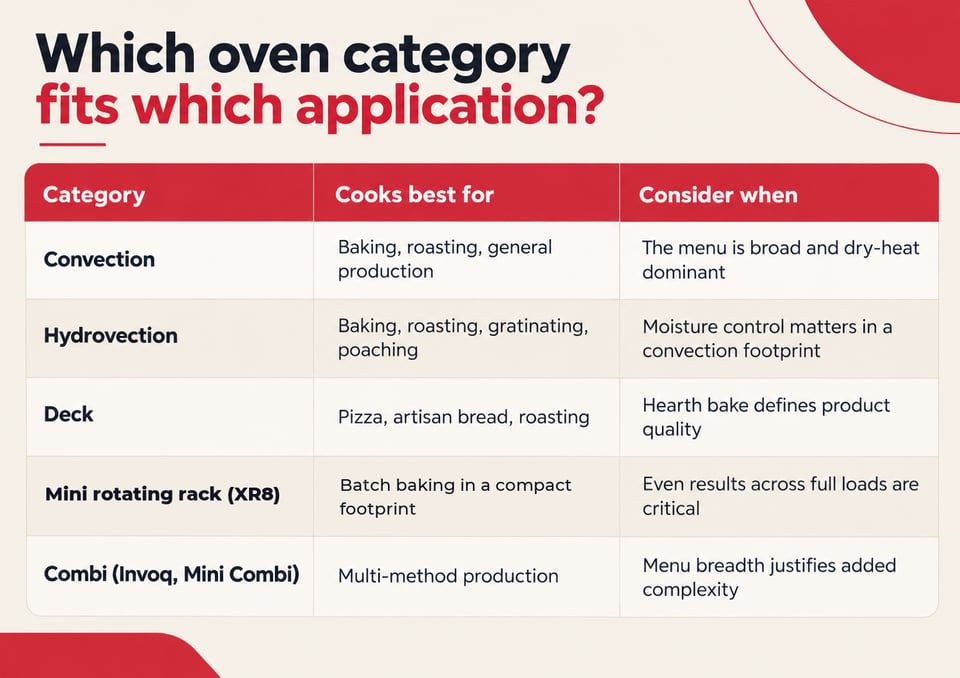
Convection covers the broadest range of general production. Blodgett describes the Hydrovection, built with Helix technology, as the only split-door, continuously humidified oven on the market, which extends convection into moisture-dependent cooking. Deck and rotating rack ovens serve baking-driven operations. Combi suits kitchens whose breadth of menus justifies the added training.
How much capacity does the operation need?
Capacity is a peak problem, not an average problem. An oven sized to annual average volume bottlenecks during season and sits half-loaded the rest of the year.
Four inputs make the calculation real: batch size at peak, the pan format already in use, how the kitchen loads during service, and how quickly the oven recovers between batches.
Recovery speed is the one most often skipped. Adequate cavity volume still creates a bottleneck if temperature lags behind service pace.
What space and ventilation allow
Footprint, door clearance, and hood capacity narrow the field before the menu enters the conversation. Many Florida kitchens run in leased or older buildings where adding hood capacity is expensive or not permitted.
The Hydrovection fits a 38-inch footprint, the same as a standard convection oven. For kitchens without hood space, Blodgett's Hoodini system supports ventless convection, Hydrovection, mini-combi, and Invoq configurations. Certifications vary by model, so confirm before specifying.
What to gather before specification
- Menu items, batch sizes, and daily volumes
- Peak service windows and seasonal swing
- Pan and rack formats currently in use
- Available footprint, clearance, and utility connections
- Hood capacity, or confirmation that none exists
- Staff experience with programmable controls
Talk it through before you specify
The most common mistake is buying based on feature count or familiarity instead of application fit. The second is sizing to today's volume without accounting for how demand moves across the year.
Eaton Marketing works through those questions with operators, dealers, and consultants across Florida, including hands-on evaluation in the test kitchen. Contact Eaton to talk through menu and capacity before specification begins.
Eaton Marketing's team of experts helps Florida foodservice operations become more efficient and experience greater profits. Schedule a free foodservice equipment assessment with one of our team members to learn more.
Frequently Asked Questions About Commercial Ovens
What is the difference between a convection oven and a Hydrovection oven?
Both circulate heated air. The Hydrovection adds continuous humidity within the same compact footprint, extending its use to moisture-dependent cooking like poaching and gratinating. Convection alone stays in dry-heat territory.
Does a ventless oven still need a hood?
Ventless models using the Hoodini system are designed to operate without a commercial hood. Certification is model-specific, and local code still governs installation, so confirm approvals before ordering.
Should a commercial oven be gas or electric?
Utility availability and local code usually decide it. Blodgett's convection line includes both gas and electric models, with ENERGY STAR qualification on several. Ventless configurations are electric only. Hydrovection is available in both.
How do you know when an operation has outgrown its oven?
Watch for batching that spills past the ticket window, menu items dropped because the oven cannot hold the right condition, and staff staging production hours ahead to compensate.