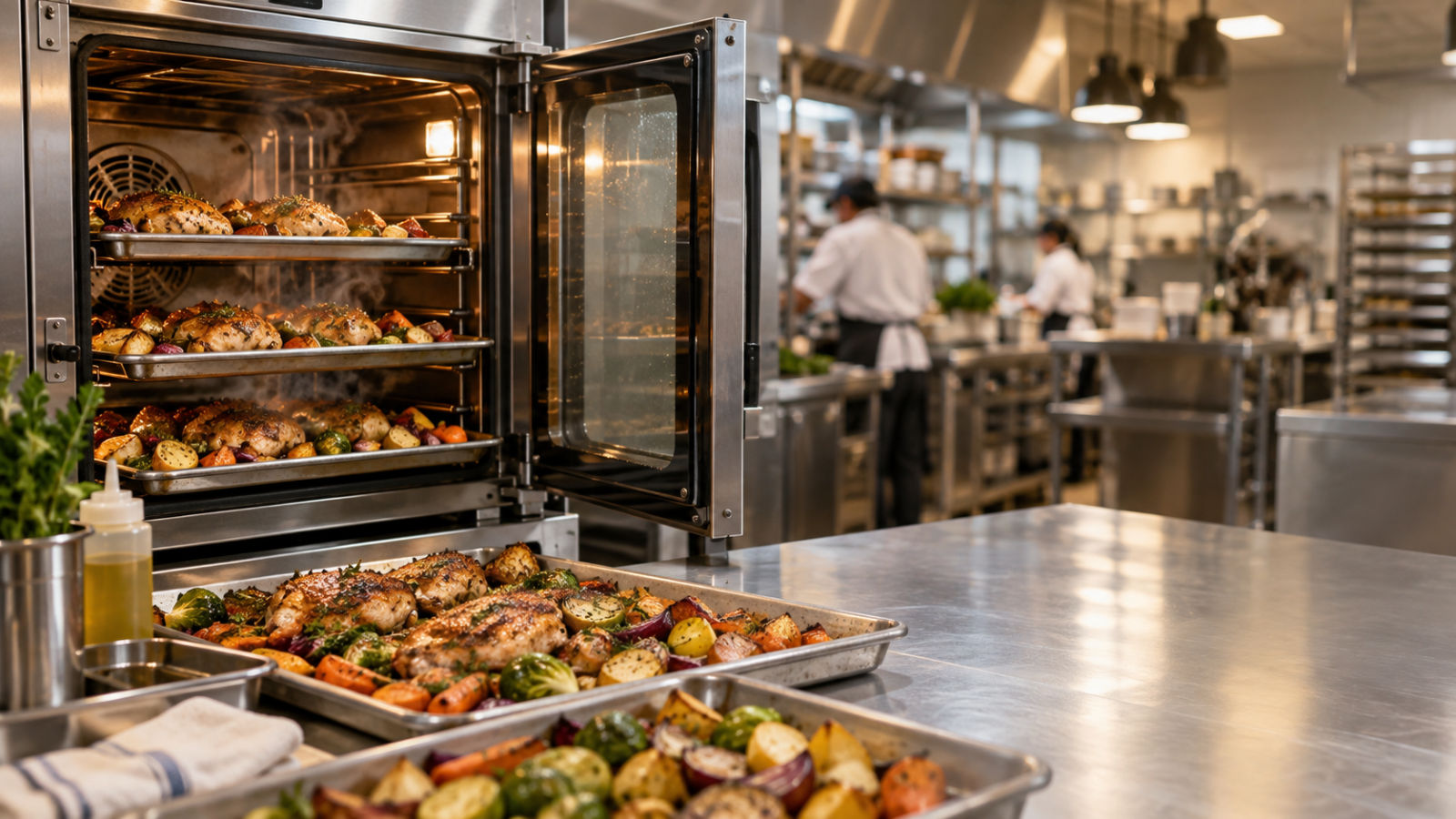
Plenty of Florida kitchens are running a combi oven as a convection oven. The steam modes get used for a few weeks after install, then the line gets busy and the crew falls back to what they already know. The oven works, but the operation just paid for a capability it never touches.
That is the real question behind a Hydrovection-versus-combi decision, and the answer depends on the menu more than on the oven. A Hydrovection adds controlled humidity to convection cooking inside a standard convection footprint. A combi treats steam as its own cooking mode and adds the utilities, cleaning routine, and training that come with it. If your menu needs moisture as an enhancement, the first one fits. If your menu needs steam as a method, the second one does.
What is a Hydrovection oven?
Blodgett's Hydrovection line, the HVH models, injects humidity continuously into a convection cavity. The split door and 38-inch footprint match a standard convection oven, which matters when the replacement must fit within an existing line without moving hoods or reworking utility runs. Blodgett describes the applications as baking, roasting, gratinating, and poaching.
Blodgett describes it as cooking with humidity or hot air. It doesn't offer the separate steam-only mode a combi does, and that is the main line between the two.
What is a combi oven?
A combi runs convection, steam, and a combination of the two as three separate modes. Blodgett's combi lineup includes the Heavy Duty BX Series and Invoq, which Blodgett builds as full-size, multi-rack units in a low footprint.
The third mode is the whole point. Steam-only earns its place on menus built around delicate proteins, vegetables held to a texture standard, and volume retherm where the alternative is drying out product across a long service. If none of that describes your menu, the mode sits unused and you are paying to maintain it.
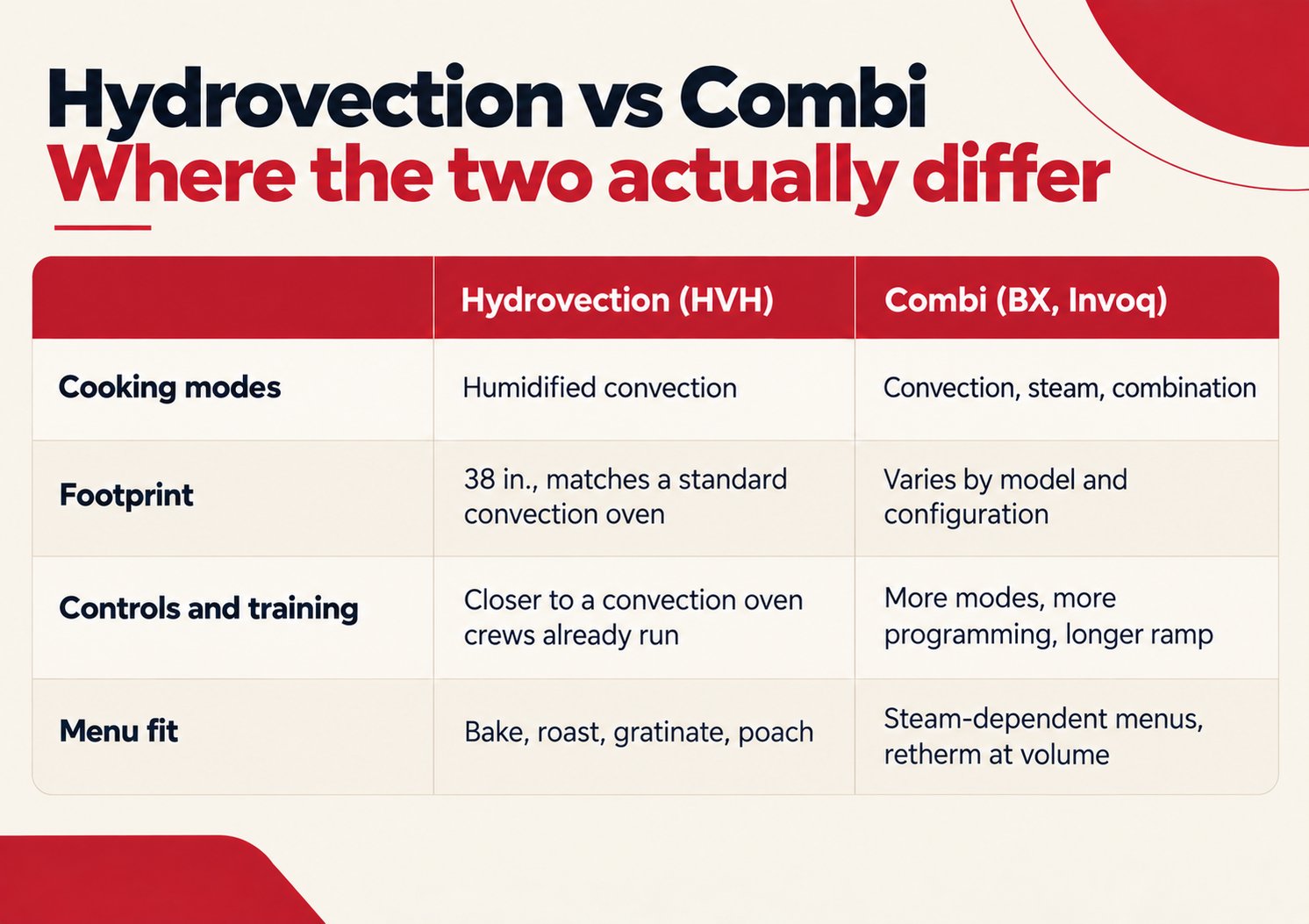
The pattern underneath the table is that a combi buys range and a Hydrovection buys fit. Range is worth paying for when the menu uses it. When it does not, the second column turns into installation cost, water treatment, chemical inventory and training hours that never convert into plate quality.
Which kitchen fits which oven?
Replacing a convection oven inside a fixed line. A hotel kitchen or a school that needs better crust and yield on what it already bakes, in a space with no room to grow. The footprint match is doing the work here, not the mode count. Hydrovection.
A scratch kitchen with a steam-dependent menu. A resort restaurant running sous vide finishing, vegetable cookery, and proteins to a temperature standard. Steam is a method on this menu, not a nice-to-have, and the training investment has somewhere to land. Combi.
High-volume retherm and hold. A hospital, a stadium, or a country club pushing banquet service. The decision turns on production math and hold quality more than on either category's headline features. Both lines have models built for it, which is why this scenario goes to a demo rather than a spec sheet.
Florida adds one variable worth naming early. Steam-generating equipment is sensitive to incoming water, and hardness varies sharply between municipalities across the state. Two kitchens, forty minutes apart, can face different treatment requirements for the same oven. That is a site question, not a category question, and it belongs in the conversation before the purchase order.
What to resolve before you spec either one
Bring these to a demo or a technical consultation:
- Which menu items need steam as a method, not as an enhancement?
- How many of those items run daily versus occasionally?
- What is the incoming water hardness at the site, and what treatment is specified?
- Is there a floor drain and water supply where the oven has to sit?
- What is the exact footprint available, including door swing and service clearance?
- Who programs the oven, and who runs it on a Saturday night?
- What does the cleaning routine cost in labor and chemicals per week?
- What ventilation does each model require at this site?
Dealers can use the same list to qualify a customer before quoting. Consultants will recognize most of it as early spec work that saves a change order later.
The oven that fits is the one whose capabilities show up on the line every day. Everything else is depreciation.
Eaton Marketing's Oven Selector is coming soon and will walk through these questions in a few minutes. In the meantime, our Clearwater and Fort Lauderdale test kitchens can put both categories in front of your team with your own product.
Eaton Marketing's team of experts helps Florida foodservice operations become more efficient and experience greater profits. Schedule a free foodservice equipment assessment with one of our team members to learn more.

Frequently Asked Questions About Hydrovection and Combi Ovens
What is the difference between a Hydrovection oven and a combi oven?
A Hydrovection adds continuous humidity to convection cooking. A combi runs convection, steam and combination as three separate modes. The practical difference is whether steam is available as a cooking method on its own or only as support for convection.
Can a Hydrovection replace a combi oven?
It depends on whether the menu uses steam-only cooking. A Hydrovection covers baking, roasting, gratinating and poaching. If a kitchen relies on a dedicated steam mode for proteins, vegetables or retherm, a Hydrovection will not cover that work.
Does a combi oven need a water line and a drain?
Yes, and water quality matters as much as water access. Requirements vary by model and by the incoming water at the site, which in Florida can differ significantly between municipalities. Confirm both the connection requirements and the specified treatment before install.
Does a Hydrovection oven fit where a convection oven is now?
In most cases, yes. Blodgett builds the Hydrovection in a 38-inch footprint, the same as a standard convection oven, with a split door. That makes it a common choice when a replacement has to fit an existing line without moving hoods or reworking utility runs. Confirm the exact clearances and utility requirements for your site before you order.